The Vision Behind The Off Grid Ark
Building Eastern Ontario’s Most Authentic Outdoor Education & Leadership Facility
The Off Grid Ark was never meant to be “just another camp.”
From the beginning, my vision has been clear: to build the premiere outdoor education and youth leadership facility serving Eastern Ontario, without drifting into the high-overhead, high-cost, corporate model that dominates the space today.
I wanted something different. Something closer to the original spirit of outdoor education, where challenge builds confidence, leadership is learned through experience, and the land itself is the classroom.
That vision rests on three non-negotiable pillars: accessible, inclusive, and educational.
Why Location Matters: Close Enough to Be Practical, Far Enough to Feel Wild
The Off Grid Ark sits on 164 private acres of forest, just 45 minutes from Ottawa.
That distance is important.
We’re close enough that groups can leave school in the morning and return the same afternoon. Yet the moment students step onto the property, the urban world completely disappears.
There are no roads cutting through the site, no tourists walking through. No overlapping school groups. No background noise.
Just forest, trails, and focus.
That balance—easy access paired with total immersion is rare, and it’s one of the Ark’s greatest strengths.
True Inclusion: Why I Built It This Way (And Why I Was Part of the Problem)

I was always in the stern steering, and my boat was ALWAYS in the lead.
I didn’t arrive at this model by accident.
When I was in high school, I was the fit, energetic kid on our John Rudolph led "Wilderness Skills" trips. On hikes in places like Algonquin, a couple of my buddies and I were always out front. We’d hit the next stop and sit around waiting while the "slow kids" trickled in behind us.
We were bored.
And I’m sure the slower students felt pressured, frustrated, or embarrassed trying to keep up.
Canoe trips were even worse. We had the fitness and the skill. In wind or rough water, Scott, Todd, Dorothy and I pulled farther and farther ahead while the weaker ones struggled just to stay on line. The gap wasn’t just physical — it was emotional and social.

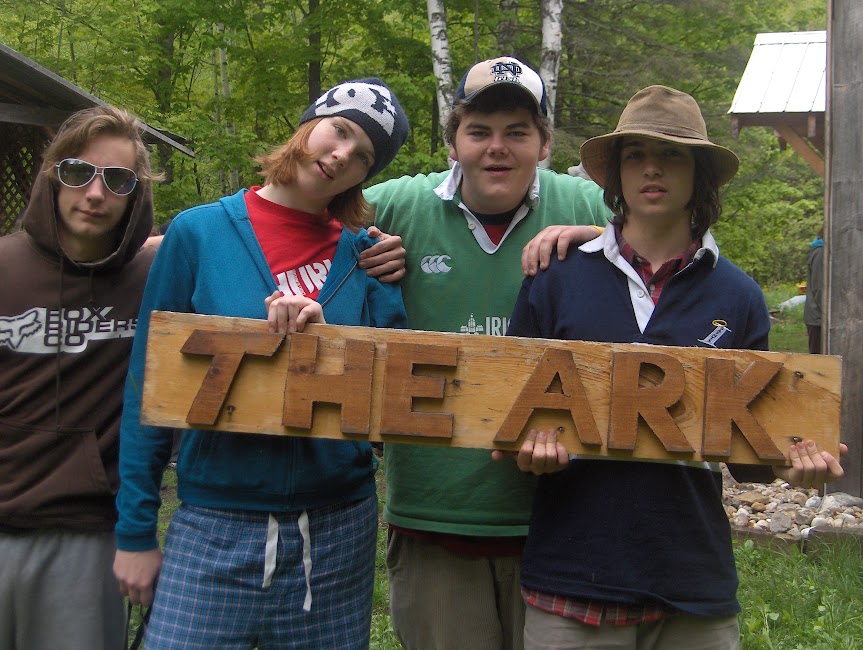
The "cool kids" - me, Todd, Scott and Dorothy
At the time, I didn’t think much of it. In fact, I felt pretty cool being “the strong one.”
Looking back, I realize I was part of the problem.
Traditional expedition-style trips quietly reward endurance, strength, and technical ability. Even when everyone is technically included, the experience isn’t equal. Pace decides who leads, who waits, and who feels exposed.
The Off Grid Ark was built as a direct response to that.
Instead of long point-to-point hikes or paddles where speed dictates the experience, programs here are designed around short movements, decision points, and team-based challenges. Leadership isn’t about being the fastest or strongest — it’s about planning, communication, awareness, and follow-through.
That keeps:
strong, capable students engaged without standing around waiting
less-fit students involved without feeling like they’re holding the group back
teams working together instead of stretching apart
This philosophy didn’t come from a textbook.
It came from being the "cool kid, jock" — the one out front — and later standing on the other side as an instructor, watching the same dynamics play out again and again. Seeing who actually learns, who adapts, and who grows under pressure is what showed me there was a better way to build leaders.
Education First: Leadership Is Learned, Not Lectured
At its core, The Off Grid Ark is an educational environment.
Leadership here is not taught through slides or theory. It’s learned through:
navigation challenges
decision-making under pressure
teamwork in unfamiliar terrain
problem-solving when plans fail
reflection after real effort
Activities like Mantracker-style navigation and crisis scenarios aren’t games—they’re structured learning tools. Students don’t just participate; they discover what they’re capable of.
This is experiential education in its purest form.
The Gold Standard—and Where I Chose a Different Path

The Off Grid Ark bunkhouse will most likely never be as fancy as Bark Lake.
There is no denying the legacy of Bark Lake Leadership Centre.
For decades, Bark Lake has been considered the gold standard in Ontario outdoor education. Many educators, including myself, hold deep respect for what it represented, especially in its early years.
But over time, the model changed.
Modern Bark Lake operates as a large-scale, high-infrastructure facility with commercial kitchens, extensive staffing, and rigid program packages. That scale comes with value—but also with cost, complexity, and a very different feel.
The Off Grid Ark deliberately chose another route.
A Lean, Boutique Alternative to the “Big Box” Model
What Local Outdoor Education Pricing Really Looks Like (2026)
When schools compare pricing, it’s important to understand what’s actually being compared. Outdoor education pricing in our region varies widely depending on subsidy, infrastructure, group size, and whether the site is public, shared, or fully facilitated.
At the low end, places like Gatineau Park operate as public-access sites. Costs are minimal — often under $10 per student — but these are essentially site permits, not programs. There’s no instruction, no exclusivity, and groups share space with the public.
Board-run sites such as MacSkimming typically fall in the $10–$14 per student range for day use. These programs benefit from heavy subsidy and scale. They’re well-run, but high-volume by necessity, with limited flexibility and generally no overnight options for non-board groups.
Established camps like Camp Livingstone tend to sit around $30–$35 per student for day programming, with overnights often landing between $75–$100 per student. These sites offer shared amenities and traditional camp-style programming, usually with multiple groups on site at once.
Facilities such as Silver Lake span a wide range — roughly $16–$35 per student for day programs and $79–$99 for overnights — depending on staffing ratios and specialty add-ons like climbing or canoeing.
At the high end, premium residential centres like Cedar Ridge operate at $75–$95 per student for day programs and $125+ for overnights. These include full facilitation, large permanent staff teams, and significant infrastructure costs.
Against that backdrop, The Off Grid Ark’s per-student program fees — $17.50–$25 for day programs and $45–$50 for overnights — sit within the local range, not outside it.
What’s different is the structure.
Rather than bundling everything into a single high per-student fee, the Ark follows a site-first, lean premium model.
Schools pay:
a flat site fee for exclusive use of a private 164-acre property
a transparent per-student program fee based on the level of instruction
This separates infrastructure costs from instructional costs — something most facilities don’t do.
For schools with qualified outdoor education staff, this means:
no paying for redundant facilitation
freedom to self-cater and control schedules
flexibility to shape the day around learning goals rather than preset packages
That model is very different from large centres like Bark Lake Leadership Centre, which operate on a high-infrastructure, bundled approach. Day programs there are typically around $68 per student, with overnights often exceeding $170 per student once facilitation and food are included. Those costs reflect scale and amenities — not necessarily better alignment for every school.
By keeping overhead lean and separating site access from programming, the Ark allows schools to pay only for what they actually need.
The result is often significant cost savings, especially for overnight programs — while still offering something many lower-cost options can’t: total site exclusivity, focused leadership programming, and a true off-grid learning environment.
Exclusivity as a Leadership Tool
One of the Ark’s most overlooked advantages is total exclusivity.
At larger centres, even expansive ones, students share space with multiple groups. That inevitably dilutes focus and ownership.
At the Ark, one group has the entire forest.
That sense of ownership changes behavior. Students take responsibility. Teams settle in. Leaders emerge naturally when there are no spectators and no distractions.
For many private and independent schools, having a site to themselves isn’t about luxury, it directly supports focus, safety, and better learning outcomes.
Off-Grid by Design, Not by Branding
The Ark isn’t styled to look off-grid. It is off-grid.
Solar power, wood heat, simple systems, and intentional limits aren’t aesthetics—they’re teaching tools. Students see sustainability in action. They experience resilience instead of hearing about it.
In a time when “digital detox” and environmental literacy are becoming core educational priorities, authenticity matters.
This is not simulated resilience. It’s real.
A Spiritual Successor to the Early Days of Outdoor Education
In many ways, the Off Grid Ark resembles what legendary centres like Bark Lake once were in their earliest years, small, intentional, rugged, and deeply human.
Before the commercial kitchens. Before the corporate retreats. Before scale replaced mentorship.
The Ark is still in its pioneer phase. Built by hand. Shaped by trial and error. Focused on small groups and meaningful outcomes.
That’s not a limitation. It’s the point.
Looking Ahead to 2026 and Beyond
Despite operating without the government funding many competitors rely on, the goal remains the same:
To be price-competitive, educationally superior, and authentically different.
Not bigger.
Not louder.
Not more polished.
Just more real.
The Off Grid Ark exists for schools, families, and educators who believe leadership is built through experience—and that confidence doesn’t come from encouragement alone, but from overcoming something real.
That belief is what the Ark was built for, and it’s what will guide everything that comes next.


