When the Load Falls Off the Trailer
Some days, progress comes from building.
Other days, it comes from dealing with everything that tries to stop you from building.
This was one of those days.
A Small Window to Move Forward
Yesterday, we had one of those rare breaks in the weather—10 degrees and rain. I took the opportunity to head up the hill with a shovel and break up as much of the ice as I could. The goal wasn’t to clear it completely, but to rough it up enough that when it froze again, the surface would have some texture—something the tracks could actually grip.
By morning, a few inches of snow had come down, which actually works in my favor. Snow gives you traction, and if you do start to slide, it builds up under the tracks and helps stop you before things get out of control.
It felt like a good window to move another load of cedar up to the Shelter.
The Moment Everything Slid Back
I loaded the trailer with what I thought was a solid stack of boards and started up the hill.
About three-quarters of the way up, something made me glance back.
The trailer was empty.
Every board had slid off the back.
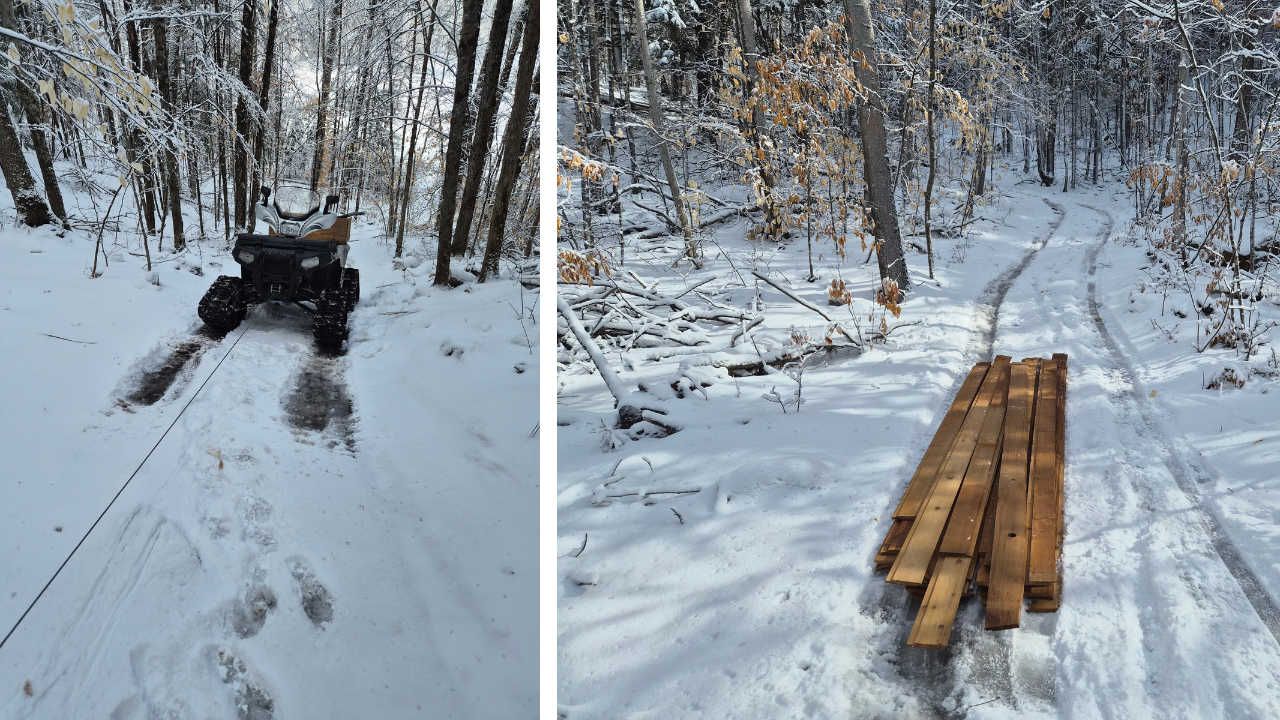
There was a thin layer of ice along the edges of the trailer, and I hadn’t been able to clamp the load down tightly enough. As soon as the hill got steep, gravity took over and dropped the entire load right at the base.
When I slowed down to look, the tracks spun, exposed the ice underneath, and that was it.
No traction. No momentum.
Back to the winch.
Getting Up Is Only Half the Work
I winched myself up the steep section of the hill, one controlled pull at a time, and once I cleared that section, I was able to drive the rest of the way up to the Shelter.
But the cedar was still at the bottom.
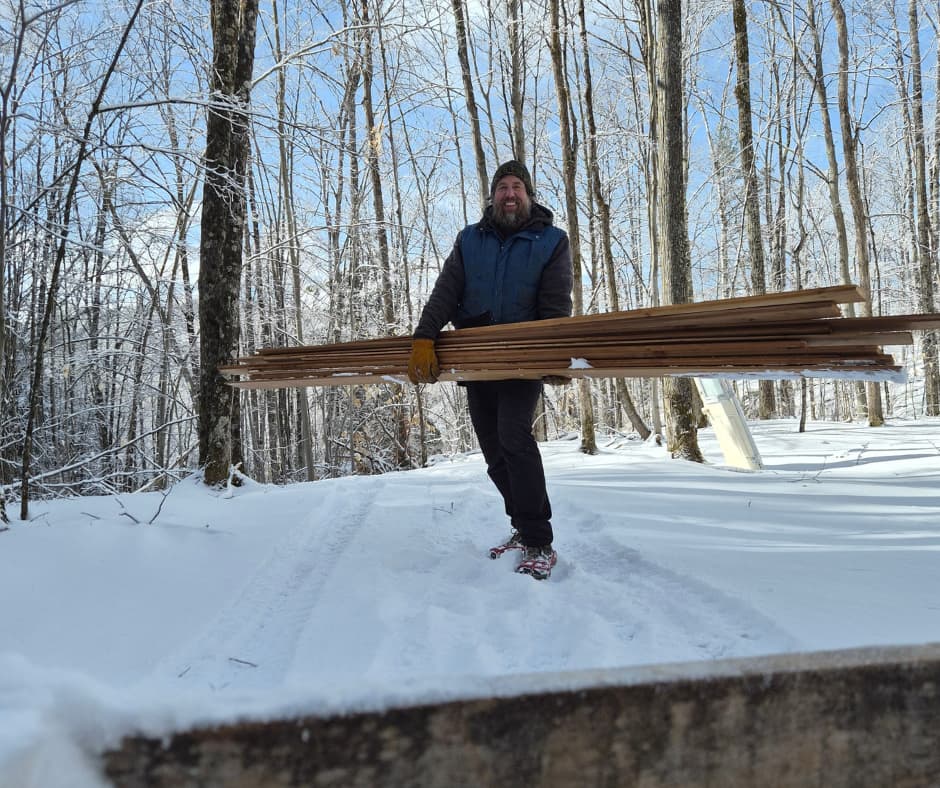
So it turned into five trips on foot, carrying each load up the hill by hand.
That’s the kind of work that doesn’t show up in the final build—but it’s a big part of what it takes to get there.
s
The Part You Don’t See in the Photos
Most of the progress lately has been overhead—installing the ceiling vapor barrier and then moving into the cedar.
That kind of work is always tiring, but it’s been a different challenge with my shoulder. I’ve been dealing with a bad shoulder for a while now, and working with my arms up for hours at a time has made it pretty clear it’s not something I can just ignore.
I’ve been pushing through it, because the work needs to get done, but it definitely slows things down. There’s more pacing, more breaks, and a constant awareness that some days, progress is limited not by time—but by what my body will allow.
It’s just another layer to the build that doesn’t show up in the finished space.
Where the Build Stands Right Now
Despite all of that, the Shelter is starting to come together.
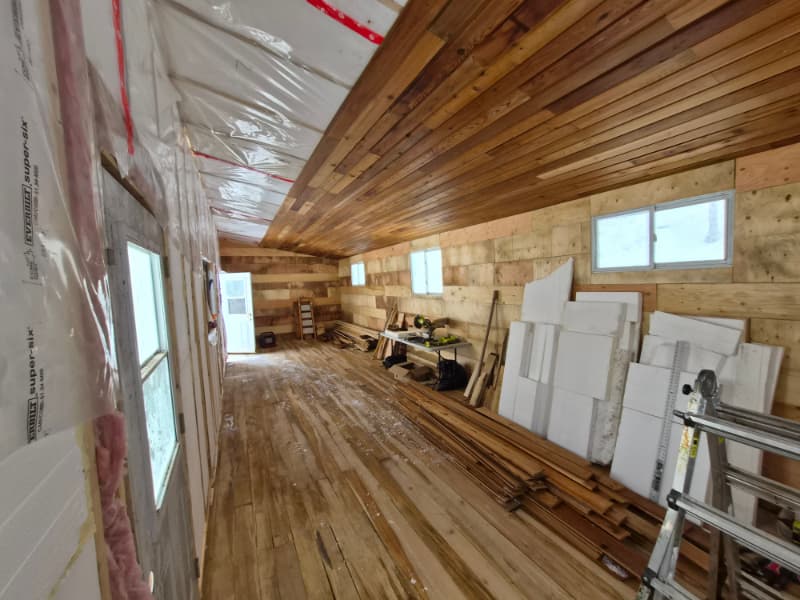
The ceiling is now about seventy percent covered in western red cedar, and it’s completely changed the feel of the space. It’s warmer, quieter, and starting to feel like something intentional instead of just a framed structure.
The building is now fully enclosed, and that alone is a major shift. With a small propane heater running, it’s comfortable enough to work inside without gloves and barely even a jacket. After a winter of working in the cold, that changes everything.
On the walls, I’ve got plywood up on two sides—one long wall and one short wall.
And that’s where I hit a bit of a crossroads.
When “Rustic” Doesn’t Quite Work
In photos, the plywood actually looks pretty good. It has that rough, patchwork look that feels like it could pass as rustic.
In real life, it doesn’t land the same way.
Up close, it looks like what it is—scrap plywood, mismatched tones, stains, and pieces that don’t quite belong together. More “leftover material” than “intentional design.”
That’s been a bit of a mental battle.
Because I know this isn’t meant to be a high-end Muskoka build. It’s an off-grid shelter, a clubhouse. But at the same time, I don’t want it to feel thrown together. I want it to feel solid. Clean. Something people walk into and immediately feel good about.
A Simple Direction Forward
After going back and forth on it, I decided to stop trying to make the plywood look like something it’s not.
Instead, I’m going to paint it completely.
The long wall will be a soft beige
The short end wall will be a darker moss or forest green as a feature
That way, none of the grain, staining, or inconsistencies show through, and the space feels more cohesive.
On the opposite end, where the kitchen will go, most of that wall will be covered by cupboards anyway. So that section becomes more about function than finish.
Why This Still Comes First
As much as there are other pieces to this project—programming, weekends, marketing—none of that really moves forward until this space is finished.
The Shelter is the centerpiece.
It’s the clubhouse, the gathering space, and the quiet room. It’s what makes the entire concept work in a practical way. Without it, it’s hard to show people what this experience actually is.
Now that it’s enclosed and usable, it’s getting close—but until it’s finished, this is still the priority.
Everything else comes after.
Where Things Sit
Progress is steady, even if it comes with setbacks like this one.
The ceiling is coming together. The walls are taking shape. The space is starting to feel real.
And some days, progress looks less like building—and more like carrying the same load up a hill five times because it fell off your trailer.
That’s just part of it.


