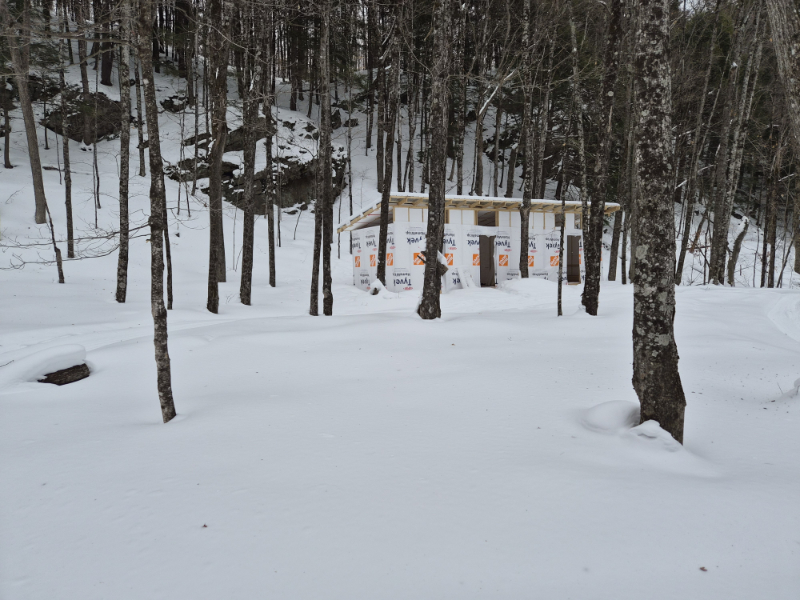
The Bunkhouse Is Dead (and What’s Replacing It)
This winter’s build season has forced me to slow down in ways I didn’t fully expect. Some of that has been weather. Some of it has been logistics. But a bigger part of it has been clarity.
Over the past year, I’ve had a lot of conversations about hosting high school groups here. There’s real interest in outdoor education, leadership-style programming, and getting students out of the classroom and into the woods. The camps we’ve hosted in the past were incredibly successful. The kids were engaged, challenged, and clearly got something meaningful out of the experience.
I still want to host those groups.
But if I’m honest, I haven’t figured out how to consistently market to schools, and I can’t force anyone to come. Interest alone doesn’t turn into bookings, and rather than fight that reality, I’ve decided to stop building around assumptions and start building around certainty.
What Became Clear Over Time
While the school conversations were happening, something else was unfolding quietly in the background.
It started at one of Monique’s work events last week. I ended up talking with one of her coworkers who has two autistic children, and at some point the conversation turned to what I’d been building here and the idea of parent–youth adventure weekends. As I described it, he stopped me and said that a weekend like that would be almost perfect for a family like his — with a few changes, of course. That comment stuck with me. When I got home, I started digging into the numbers and the available programs, and that’s when I realized just how large the gap really is.
In most regions, there are many supports and programs available for younger autistic children, particularly in the early years. Those programs are often therapy-focused, school-adjacent, or designed around short, structured sessions.
But as kids get older — especially in the 9–18 age range — those options fall away quickly. Recreational programs become harder to access, traditional camps are often a poor fit, and family-inclusive outdoor experiences are almost nonexistent.
That gap is what finally came into focus.
There are plenty of programs aimed at younger children. There are also clinical or therapy-based options. But for families with autistic or neurodivergent youth in the 9–18 age range, the options narrow dramatically — especially when it comes to outdoor, adventure-based experiences that are still accessible and humane.
This isn’t a niche issue. Regionally, there are thousands of families navigating this same transition, actively looking for meaningful experiences that don’t require clinical framing or unrealistic expectations. In many cases, there is also government funding available to families, which removes any financial burden of participation. And unlike schools, these families aren’t bound by boards, buses, or approval cycles. When something fits, they can actually say yes.
Why the Bunkhouse No Longer Fits
The original bunkhouse design made sense for school groups and traditional camps. Shared sleeping. One big space. High efficiency.
But it wasn't being booked and it doesn’t serve this new audience well.
Families navigating neurodivergence don’t need more institutional environments. They need choice, predictability, and somewhere to land when things get hard — without having to ask for special permission or explain themselves.
That realization changed the entire project.
So I’m calling it what it is.
The bunkhouse, as originally envisioned, is dead.
Reframing the Build: Shelter, Commons, and Quiet Rooms
What’s replacing it isn’t bigger or more complex. It’s more intentional.
The structure is now being designed as a Shelter, built around two clear functions:
a Commons space for meals, gathering, orientation, and weather protection
a dedicated Quiet Room for decompression, regulation, or simply taking a break
Everything remains outdoor-first. The Shelter isn’t a destination; it’s a support system. But having it changes what’s possible.
Families can say yes more easily.
Youth can participate without fear of being trapped in an environment that escalates stress.
Parents don’t have to advocate or negotiate in the moment — the option already exists.
Why This Shift Is So Promising
This pivot isn’t about abandoning outdoor education or schools. It’s about focusing on the audience where the need is clearest and the impact can be immediate.
For autistic and neurodivergent youth, especially in the teen years, there’s a well-documented “service cliff.” Supports drop off just as independence, confidence, and real-world skill-building become more important than ever.
What’s missing isn’t adventure or difficulty. Families are already willing to try hard things. What’s missing is an environment where those challenges are paired with predictability, support, and a way to step back without failing the experience.
A parent–youth adventure model solves several problems at once:
parents remain present and responsible
activities are shared, not supervised from the sidelines
skills are learned through doing, not instruction
connection happens naturally, without clinical framing
When you remove logistical friction — gear, meals, structure, sensory overwhelm — families can focus on the experience itself. That’s where growth happens.
What This Means Going Forward
I’m still open to hosting high school outdoor education camps, and I genuinely hope to. The programs work. The kids benefit. I absolutely love them! That door isn’t closed.
But the Shelter is being built first and foremost for families who are ready now — families actively looking for something like this, and relieved to find it exists.
This isn’t a retreat from ambition. It’s alignment.
Instead of building a space and hoping the right people show up, I’m building for people who already need the space.
The bunkhouse had beds.
The Shelter has intention.
And that feels like the right direction to keep building in.


