Bunkhouse Build Update — January 6
My plan was to have the bunkhouse functional by the start of December.
It’s January 6th… and I’m not there yet.
I’m frustrated.
This winter has been the coldest I can remember in recent years, and it has slowed everything down more than I expected. Building with frozen fingers is hard enough. Doing detailed work with gloves on makes it even tougher. Everything takes longer. Every step feels heavier.
Cold, Rain, and Ice Don’t Care About Timelines
Ironically, we did get a warm stretch a couple of weeks ago—but it came with rain. Five degrees and rain meant I couldn’t work, and it also laid down a solid layer of ice on the trail up to the cabin.
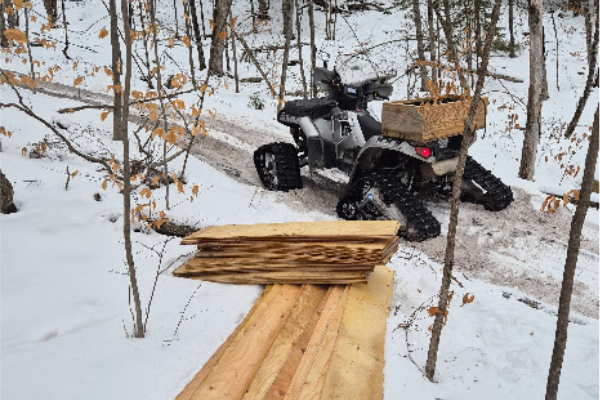
The ATV tracks are great on snow. On ice, they’re worthless.
Twice now I’ve almost made it to the top of the climb before the tracks started spinning. Both times I slid back down the hill backwards, unable to steer, with a trailer on. It’s a special kind of heart-pounding exhilaration. Both times I only stopped after running the trailer into a tree.
Not exactly efficient progress.

Progress Paused—for the Right Reasons
Another complicating factor is that the Cliffside Cabin was nearly fully booked over the Christmas holidays. Given the cost of building the bunkhouse, that rental income is absolutely welcome.
But I promote the cabin as private and romantic—so I can’t really be up there hammering away while a young couple is trying to enjoy some quiet time together. As frustrating as it is, that boundary matters.
I last slid down the trail two days ago. I laid down a full bag of ice-melt salt, and we’re finally getting some decent snow now. I’m hoping that means I can make it up tomorrow with the trailer.

Our first Cliffside Cabin guestbook review!
The Roof Is the Turning Point
Monique has agreed to take a day off work once I’m ready, because the next big job is installing the roof.
This is a two-person task. The EPS insulation goes in alongside the rafters, and trying to hold rafters in place while insulation continuously slides to the floor is… not ideal.
But once the roof is on, everything changes.
After that, it’s doors and windows—and then I’m finally free from excuses. I’ll be able to work indoors. I can get a propane heater running. It won’t be t-shirt weather, but it should be above zero and dry, and that makes a huge difference.
One of the most time-consuming parts so far has been shoveling snow out of the bunkhouse—over and over again. That part is on me for not being further ahead before winter fully locked in.
Quiet Progress Over the Holidays
Even though the build itself stalled at times, I did manage to make some meaningful progress over the holidays.
I cut all of the EPS insulation to size using my homemade hot-wire cutter. The sheets I had were either 4'×4' or 4'×8' and over 6 inches thick. I ripped everything down into 2-foot-wide panels at 5 inches thick so they’ll fit cleanly into the 2×6 rafters.
This was a cold job. I had to do it in the open-air garage so I wouldn’t breathe too much of the EPS fumes, which made it slow and uncomfortable—but it’s done now.
Even better, I was able to transport all of that insulation up to the cabin, so it’s stacked and waiting on the floor, ready to go.

Trimming a 4x8x7 piece of EPS down to 2x8x5 for the rafters.
I also got all the 16-foot rafters notched and cut to length.
Today, I’m adding temporary plywood supports to the rafters—something Monique and I will use to hold the insulation in place while we set the rafters. It’s one of those small prep steps that doesn’t look like progress, but makes the next phase possible.
One more bright spot was an unexpected Marketplace win. I managed to score about 750 square feet of shiplap cedar for the roof ceiling.
It’s the perfect material for this space. It’s going to look great and smell incredible—but just as important, it’s old cedar. That means it’s dry and surprisingly light. With 5-inch-wide boards, it should be the easiest possible ceiling material to install, which matters a lot when you’re working overhead in winter.

Laddy posing in front of my shiplap cedar haul... it's still full of nails, so a bit of extra work to remove them there.
The Part That’s Harder to Admit
There’s another frustration that’s been creeping in, and it’s not physical—it’s mental.
Last fall, I spoke with a number of schools who told me how difficult it was to find winter camping options, and how needed something like this would be. Those conversations were encouraging and helped justify the time, expense, and effort going into this build.
But so far, I haven’t heard from anyone asking about readiness, timelines, or when they could book. No follow-up questions. No “keep us posted.” Nothing yet.
That uncertainty has been sitting in the back of my mind.
Part of me worries that I’m killing myself to finish this, only to have it sit empty. Another part of me hopes schools are simply watching quietly—following these updates and waiting until things are further along before reaching out.
I really hope that’s the case.
Because a lot of time, energy, and money is going into this build, and as winter drags on, the pressure is starting to feel real.
We’re Getting Close
Despite all of that, I can finally see the turning point.
Once the roof is on and the building is sealed up, progress accelerates. Work becomes predictable again. Dry. Warmer. More controllable.
I’m not finished yet—but we’re getting close.
If things go right over the next stretch, I’m hopeful my next update comes with some genuinely exciting progress to share.


